Why does a packraft want to turn?
One of the first things people notice when they paddle a packraft is that it turns very easily. You dip your paddle in the water, pull back, and instead of scooting forward, the boat mainly just spins around. If you’re not prepared for this, you might find it really annoying and wonder if there’s something wrong with the boat’s design. Actually, this is normal packraft handling, and fortunately it’s easy to minimize this side to side motion with good paddling technique. I’ll give you some paddling tips below, but first the physics nerd in me is dying to get out, so here’s a bit about why packrafts have so little directional stability:
In general,
- Long, skinny boats (like sea kayaks, canoes, and ocean liners) have greater directional stability than short, tubby boats (like dinghies and river kayaks). This is because in order to spin a long boat you have to push a lot of water out of the way. You can demonstrate this phenomenon to yourself next time you’re wading in neck-deep water: with your arms pointing down beside your body (like a short boat), it’s easy to swivel your body from side to side, but if you hold your arms rigidly straight out from your body, side to side (like a long, skinny boat), it becomes a lot harder to swivel your body because you have to overcome the resistance of your arms pushing against a lot more water. It’s also because they have a greater “moment of inertia,” which basically means it takes more energy to rotate them because their mass is spread out farther from the center of rotation.
- Deep hulls and V-shaped hulls have better directional stability than flat bottomed boats, because a deep-hulled boat has a larger underwater profile, so more water must be pushed aside to turn it.
- Heavier boats have better directional stability than lightweight boats because
- they displace more water, so more water must be moved in order to turn them
- their greater mass gives them more inertia which must be overcome in order to turn them
- they are less affected by wind, for the reasons above
- Boats with keels have better directional stability than boats without keels because the keel acts as a large area of high length-to-width ratio underwater (similar to a long, skinny boat). The larger underwater profile means more water must be moved out of the way in order to rotate a boat with a keel.
- Boats with fins, rudders, or skegs near the stern have better directional stability than boats without those surfaces because they add area to the underwater profile of the boat behind its center of mass (similar to the fins at the rear of a dart). As the boat begins to turn, water hits the side of the fin, applying a force that pushes the rear of the boat back on track, similar to the way a weather-vane turns in the wind.
Looking at the factors above, it’s easy to see why a short, relatively wide, flat bottomed, ultralight packraft with no rudder, keel, or skeg will lack directional stability. But wait, it gets worse!
Because the paddler and gear make up about 97% of the total weight of a packraft on the water, weight distribution becomes an issue. Packrafts are designed to be as small as possible to make them light and portable, and given that the safest and most comfortable way to sit is on our butts with our legs pointing forward, that puts the bulk of our weight behind the packraft’s geometric center.
Why might that be a problem? Well, if you’ve every played a game of darts, you’ll know that each dart has a metal weight near its forward end and large, lightweight fins at the back. The weight is offset some distance from the fins by a shaft, and if you look at it from the side, you can see right away that the center of mass (a.k.a. “center of gravity”) is located far forward of the dart’s geometric center (the point where it would balance if you cut out its profile shape from a piece of paper).

This design gives darts so much directional stability that even if you throw them backwards they quickly flip around so the needle points in the direction of travel – it will oscillate back and forth a bit, but the stabilizing fins quickly dampen the oscillation and the dart flies smoothly through the air, point first. The same thing happens with a badminton shuttlecock, which has a weight on the front, and even a plastic cup partially filled with beer can be thrown and caught without spilling much beer because it has this same stable property of the center of gravity being far forward of the geometric center:
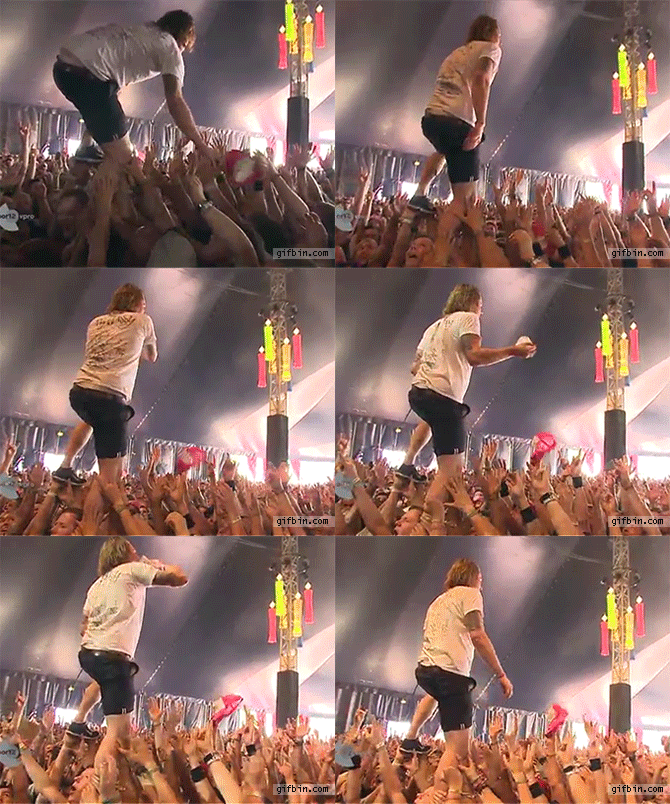
You can probably see where this is heading: with the packraft’s center of gravity being near or even behind its geometric center, as soon as you stop actively keeping it on course (i.e. paddling), the packraft starts to turn.
We can minimize this tendency by packing our gear towards the front of the packraft in order to move the center of gravity as far forward as possible, and by designing packrafts with longer and longer stern tubes, as the trend has been in recent years. Unfortunately this trend towards longer and longer packrafts comes at a cost in the form of greater weight and larger packed size, which you’ll notice on the trail. As with most things in life, it’s a trade-off.
So with all these things working against us, how are we supposed to paddle a packraft in a straight line? Well, it’s actually pretty easy, as you can see in the video below (you can also see how adding weight near the bow reduces the oscillation).
Tips for keeping your packraft on track:
- Pack your gear towards the front of the packraft. This moves the center of gravity as far forward as possible, minimizing the “dart thrown backwards” effect.
- When starting from a standstill, begin paddling with short, punchy strokes, quickly alternating from side to side, as at the beginning of the video above. This will minimize the yaw induced by each stroke.
- Once you reach cruising speed you can take normal paddle strokes and the bow will swing back and forth only a few degrees.
- A normal forward paddle stroke starts by catching the water as far forward as possible and it ends beside your hip – do not continue the stroke back past your hip!
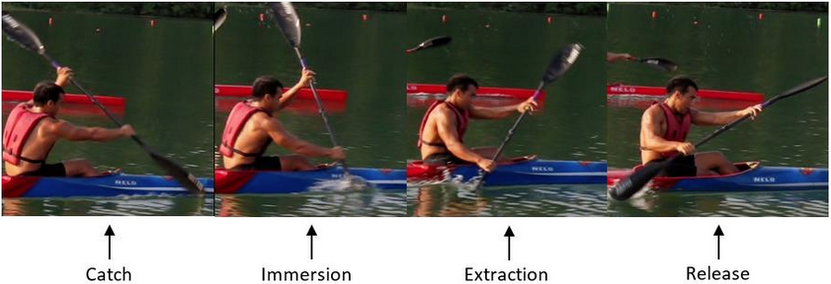
- Pay attention to your heading. By varying the power of each paddle stroke, you can make small adjustments to your heading and avoid wasting energy making big S-turns when you’re trying to travel in a straight line.
Like riding a bicycle, these paddling techniques quickly become second-nature, and before long you won’t even notice you’re doing them, but it takes practice, especially if you’re not already an experienced kayaker.
Skegs (Fins)
You might be thinking that adding a fin or skeg to the packraft would be a logical way to improve its directional stability, and in theory it could work. I haven’t tried it myself because I like the way my packrafts handle, but I have seen at least a few people adding small skegs to their packrafts – I’m not sure how well it worked for them though. The problems with adding a solid skeg are a) it adds to the weight of the packraft, b) it could catch on something and rip a hole in your boat, and c) it might just flop around if you place it where it would be most effective, which is as far back as possible on the stern cone. If you attach it to the floor fabric ahead of the stern tube it will probably have no effect because that’s almost right under the center of gravity (it would be like moving the fins of a dart to the weighted end). If you do add a skeg to your packraft, please let us know how it works out.
13 Comments